
Kettles.
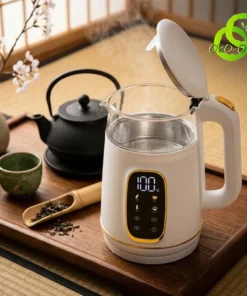
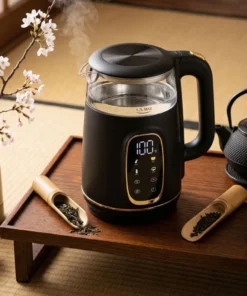
Electric with adjustable temperature, in borosilicate glass or stainless steel for induction, choose the kettle that heats water to the exact degree for each of your teas.
The history of the electric kettle.
The first model, shown in Chicago in 1891, took twelve minutes to boil water. Its heating element warmed in a separate compartment, under the container.
In 1922, an English engineer, Arthur Leslie Large, finally immersed the heating element directly in the water. Heating became much faster.
In 1955, automatic shut-off arrived: a small metal strip, deformed by steam, cut the power when the water boiled. Our kettles still work on this principle.
Kettle with automatic shut-off and keep warm.
An electric kettle does not need to be watched. It stops by itself: no more overflowing water, no more steam in the kitchen, no more heating element boiling dry.
On models with keep warm, the water stays at the right temperature for a second and third infusion.
Kettle with adjustable temperature.
Models with adjustable temperature stop at 70, 80, or 95 degrees, depending on what you prepare. The base cuts power as soon as the chosen degree is reached.
For green tea, everything depends on this. Scalded with boiling water, it turns bitter in seconds, and this bitterness cannot be fixed.
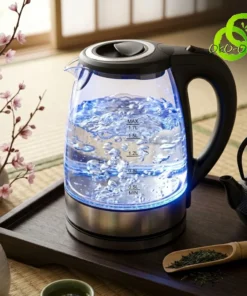
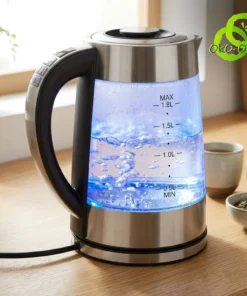
Borosilicate glass kettle.
Borosilicate glass is the same glass used in laboratories. It handles temperature changes without cracking and keeps no taste, from fruit infusion to smoked tea.
Another advantage of glass: you see the water. The level, the first bubbles, the limescale starting to form, nothing escapes you.
A stainless steel base and heating element.
In a glass kettle, the base and heating element are stainless steel. This part touches the water while heating, and food-grade stainless steel does not give any metallic taste.
This glass and stainless steel combination became the norm among tea lovers. Plastic ages badly with repeated contact with boiling water.
Traditional stainless steel kettle.
Before electric, there was the kettle placed on the stove, and it still has loyal users. Without a base or cord, it goes on an electric hob, a ceramic hob, or a gas flame.
Stainless steel is the safest metal for this use: it does not rust, gives no taste to water, and withstands years of heating.
It does not stop by itself, the whistle warns you, which is why it is called a whistling kettle. It works everywhere, even on a camping stove or during a power outage.
Kettle for induction.
Not all stainless steel works on an induction hob. An induction hob only heats magnetic bases.
Kettles designed for induction have a logo engraved under the bottom. The simplest test is a fridge magnet: if it sticks to the bottom, the kettle will heat.
Kettle or teapot, what separates them.
Both look alike and contain hot water. The difference is the filter: the teapot holds the leaves, lets them steep, then traps the sediment when serving.
The kettle heats water and nothing else. You then pour it over your leaves in the teapot of your choice.
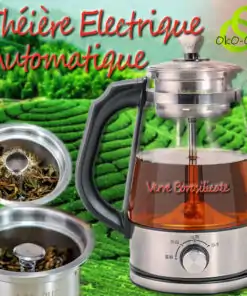
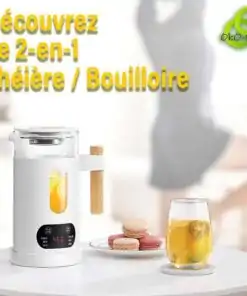
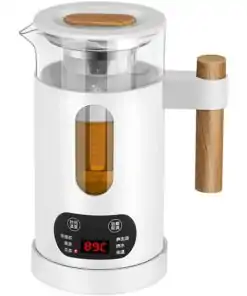
Electric 2-in-1 teapot.
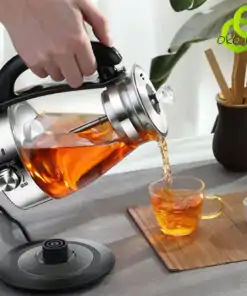
The electric teapot, also called a 2-in-1 kettle, does both. It heats water, then the infusion happens in the same glass, thanks to a removable stainless steel tea filter.
You heat water to the tea temperature, immerse the filter, remove it when the infusion suits your taste. Only one device to clean.
Without the filter, it becomes a simple kettle. For an office or student room, it is often the only device you need.
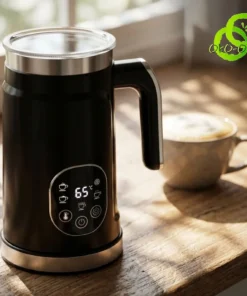
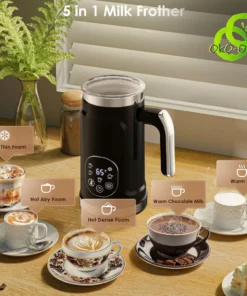
Electric milk frother and milk warmer.
A chai latte, a matcha latte, or hot chocolate require milk heated and frothed. That is the role of the electric milk frother.
It heats milk to 45, 55, or 65 degrees and froths it at the same time. One program prepares hot chocolate, another froths cold foam for iced drinks.
The milk does not burn at the bottom and never overflows.
The right temperature for each tea.
This is why an adjustable kettle pays off quickly.
| Tea | Temperature | What happens above |
|---|---|---|
| Green tea, matcha | 70 to 80 °C | leaves burn, bitterness dominates |
| White tea | 75 to 85 °C | floral notes disappear |
| Oolong | 85 to 95 °C | the aroma fades |
| Black tea | 90 to 95 °C | no problem, it tolerates it |
| Rooibos, herbal teas | 100 °C | no effect, they require boiling |
A quality green tea poured with boiling water tastes the same as a low-grade green tea. You lose the difference you paid for.
With a one-button kettle, boil, then wait a few minutes with the lid open before pouring on green tea.
How to descale a kettle.
In a glass kettle, limescale is visible, which is an advantage: you know when to act. In an opaque kettle, deposits form without warning.
Pour some white vinegar with water, bring to a boil, let sit for an hour, then rinse twice. The method works for glass and stainless steel.
Once a month is enough in hard water areas, half as often elsewhere.
Everyday kettle cleaning.
Avoid abrasive sponges: they scratch glass and stainless steel and create spots for limescale. A soft cloth does the job.
Never fill above the maximum mark. Water that overflows when boiling goes into the electrical base, causing the common failure of this device.
Electric teapot
Electric teapot